Professor Amiena Bayat

Professor Amiena Bayat

Designation: Acting Director; DSTI-NRF-Sasol Foundation SARChI Chair in Local and Regional Economic Development

Email: abayat@uwc.ac.za

Qualifications

  • Post-graduate Diploma in Survey Data Analysis for Development (University of Cape Town)
  • Ph.D in Economics (University of the Western Cape)
  • MA in Development Economics (Williams College)(Summa cum laude)
  • Certificate in Economics (University of Colorado in Boulder), Bcom Economics Honours (University of the Western Cape).

Biography

Amiena Bayat is Professor of Development Economics and Acting Director of the Institute for Social Development (ISD). She holds the DSTI/NRF Sasol Foundation Research Chair in Local and Regional Economic Development and is a collaborative partner in the UNESCO Chair in Education, Gender Equity and Wellbeing.

A development economist and interdisciplinary scholar, Professor Bayat works at the intersection of development economics, social policy, local and regional economic development, industrial transformation and sustainability. Her research has a strong global south orientation, with particular interests in food systems and food security, human capital development, industrialisation, inclusive growth, eco-industrial development and green industrial finance.

Her research is grounded in advanced quantitative, and mixed-methods approaches and is distinguished by a strong applied and policy-oriented focus. She has led and contributed to numerous national and internationally funded research and advisory initiatives, working with government institutions, multilateral organisations, development agencies, industry and academic partners. Her work has contributed to policy and programme development in areas including human capital development, local and regional economic development, industrial policy, sustainable economic transformation and inclusive development.

Professor Bayat is an experienced postgraduate supervisor, examiner and academic mentor, with extensive involvement in Masters and doctoral research in Economics, Development Studies and related fields. She has also contributed to curriculum development, postgraduate training and research capacity building.

She is actively engaged in international research and policy networks, including collaborations with United Nations agencies, development institutions and international research consortia, through which she contributes to debates on development policy, economic transformation and sustainable development.

Research projects

2025 – UNESCO Chair – Collaborative partner with the University of Minnesota, Christ University (India), and the University of the Free State in the UNESCO Chair on Wellbeing, Education, and Gender Equity.

2025 – South Africa–France PROTEA Cross-Mobility Programme (Co-PI) – The research project on Political Urbanities examines the shaping of political subjectivity through the urban experience of everyday living in specific lower middle-class neighbourhoods. Partners: Prof. Marianne Morange – INALCO; Dr Aurélie Quentin – Université Paris Nanterre.

2024–2025 – National Institute for Humanities and Social Sciences – The Changing Political Economy of Africa. This project was a collaboration with the Institute for African Alternatives (IFAA) and sought to bring together thinkers across the African continent to undertake evidence-based research. The project explores key issues facing the continent, including ecological crises, poverty and inequality, the consequences of increasing extractive activities, migration related to drought and climate change, energy dilemmas, and conflict. Project outputs included three workshops, public lectures, and the production of three accredited journal articles. 

2021 – Ongoing – UNIDO Eco-Industrial Parks Initiative (International Expert) – The Global Eco-Industrial Parks Programme (GEIPP) is implemented by the United Nations Industrial Development Organization (UNIDO) and funded by the Government of Switzerland through the State Secretariat for Economic Affairs. I have developed a range of tools and guidelines for UNIDO on access to finance for eco-industrial parks, supporting GEIPP and global south developing-country initiatives.

Recently completed

2020–2024 – ADAPTED (European Joint Doctorate) The European Joint Doctorate ADAPTED is a consortium of European universities, internationally active development organisations and think tanks, and six African partner universities, including the Institute for Social Development at UWC. The overarching aim of ADAPTED is to deliver high-level, intersectoral training focused on poverty eradication, analysing interactions between poverty reduction and other policy areas, and optimising the impact of poverty reduction policies. The programme equips early-stage researchers with a unique skills portfolio to bridge knowledge gaps in understanding poverty dynamics. 

2022–2024 – FSNet-Africa Research Fellow FSNet-Africa is a collaborative initiative between the University of Pretoria, the University of Leeds (UK), and the Food, Agriculture, and Natural Resources Policy Analysis Network (FANRPAN). It is a research excellence project funded by the Global Challenges Research Fund through the African Research Universities Alliance (ARUA)–UK Research and Innovation (UKRI) partnership. The research focused on urban food systems in South Africa, with particular attention to the Philippi Horticultural Area.


Publications

  • Bayat, A., & Govera, H. (2025). Resilience in food systems–response and adaptation to shocks and disruptions: The case of the Phillipi Horticultural Area in Cape Town, South Africa. South African Journal of Agricultural Extension, 53(4), 86–113. https://doi.org/10.17159/2413-3221/2025/v53n4a17429
  • Bayat, A., Kohli, N., & Madyibi, S. (2024). Grade repetition, school drop-out and ineffective school policy. EDUCATION: Journal of Education, 9(2), 81–93.  https://doi.org/10.29138/educatio.v9i2.1514
  • Madyibi, S., & Bayat, A. (2024). Early learning issues in Philippi, Cape Town: Caregivers’ concerns, satisfaction, subjective affordability and perceptions. Indonesian Journal of Early Childhood Education Studies, 13(2), 144–158.  https://garuda.kemdiktisaintek.go.id/documents/detail/5053930
  • Bayat, A., & Volmink, M. (2024). Towards integrating the WEF nexus into food systems thinking: A case study of the Philippi Horticultural Area. New Agenda: South African Journal of Social and Economic Policy, 94(Special Issue), 9–24. https://doi.org/10.14426/na.v94iSI.2475
  • Bayat, A., & Madyibi, S. (2023). Impact of COVID-19 on South Africa's early childhood education and the Sustainable Development Goals. In W. Leal Filho, I. R. Abubakar, I. da Silva, R. Pretorius, & K. Tarabieh (Eds.), SDGs in Africa and the Middle East region (pp. 1–27). Springer. https://doi.org/10.1007/978-3-030-91260-4_81-1
  • Bayat, A., Quinn, C., May, J., & Govera, H. (2023). Food systems approach: Reversing the trajectory of food insecurity in Africa. New Agenda: South African Journal of Social and Economic Policy, (90), 24–29. https://journals.co.za/doi/abs/10.10520/ejc-nagenda_v2023_n90_a8
  • Bayat, A., & Madyibi, S. (2022). The home environment and parental involvement of preschoolers in Philippi, a low-income area: Do they hinder or support early learning? South African Journal of Childhood Education, 12(1), Article 1055. https://doi.org/10.4102/sajce.v12i1.1055
  • Chikwanda, M., Bayat, A., & Madyibi, S. (2022). School readiness and community-based early childhood development (ECD) centres in low-income communities: Examining the case of Gugulethu, Western Cape Province, South Africa. International Journal of Emerging Issues in Early Childhood Education, 4(2), 55–69.  https://doi.org/10.31098/ijeiece.v4i2.1168

Related News

IFAA summit

IFAA summit

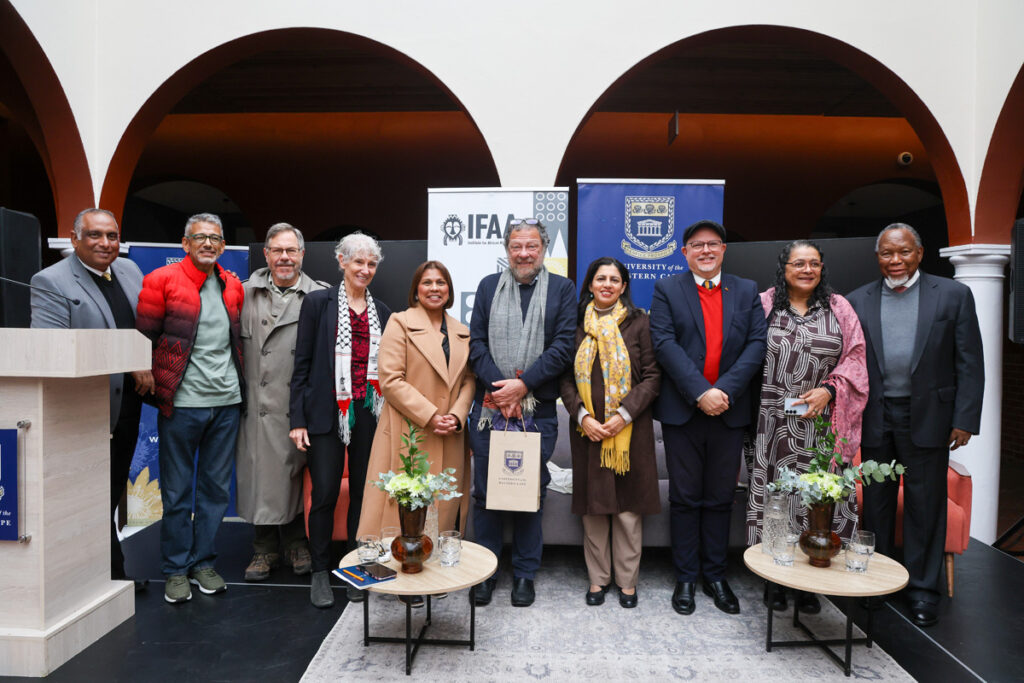
The ISD was delighted join and be associated with the Institute for African Alternatives (IFAA), who held a summit at Iyatsiba Lab in April 2026.

READ MORE