Honours
Bachelor of Development Studies Honours (1707)
The Honours programme deepens theoretical knowledge and research capacity in Development Studies. Students engage critically with key debates and complete a supervised research project.

Each year, around
students from across the globe graduate from ISD.
Selected international partners include:




The Institute for Social Development (ISD) offers a suite of postgraduate programmes in Development Studies, designed to prepare students to critically engage with pressing social, economic, and political challenges in South Africa, Africa, and the wider global context. These programmes combine rigorous academic training with practical applications, equipping graduates to become leaders, researchers, and practitioners in the field of development.
The Honours programme deepens theoretical knowledge and research capacity in Development Studies. Students engage critically with key debates and complete a supervised research project.
The structured Master’s programme combines coursework with research, offering students a balanced approach to advanced study. It provides both theoretical grounding and practical skills, preparing graduates for diverse roles in government, NGOs, and international organisations. The elective modules allow students to tailor their studies to specific interests such as poverty, inequality, or migration.
This research-focused Master’s programme is designed for students seeking to undertake rigorous, in-depth academic research in Development Studies. Candidates complete a substantial thesis that contributes original insights to the field. Graduates are well positioned for academic careers, policy research, and leadership roles within the development sector.
The PhD in Development Studies is the highest level of academic achievement in the field. It requires candidates to produce a doctoral thesis that makes a significant and original contribution to knowledge. The programme is ideal for those pursuing academic careers, high-level policy research, or leadership positions in international development.
Critical conversations and events shaping the global development landscape
All news and eventsThe Institute for Social Development (ISD) at the University of the Western Cape (UWC) is strengthening its commitment to African-centred knowledge production, postgraduate education and South–South collaboration through strategic engagements with leading African institutions.
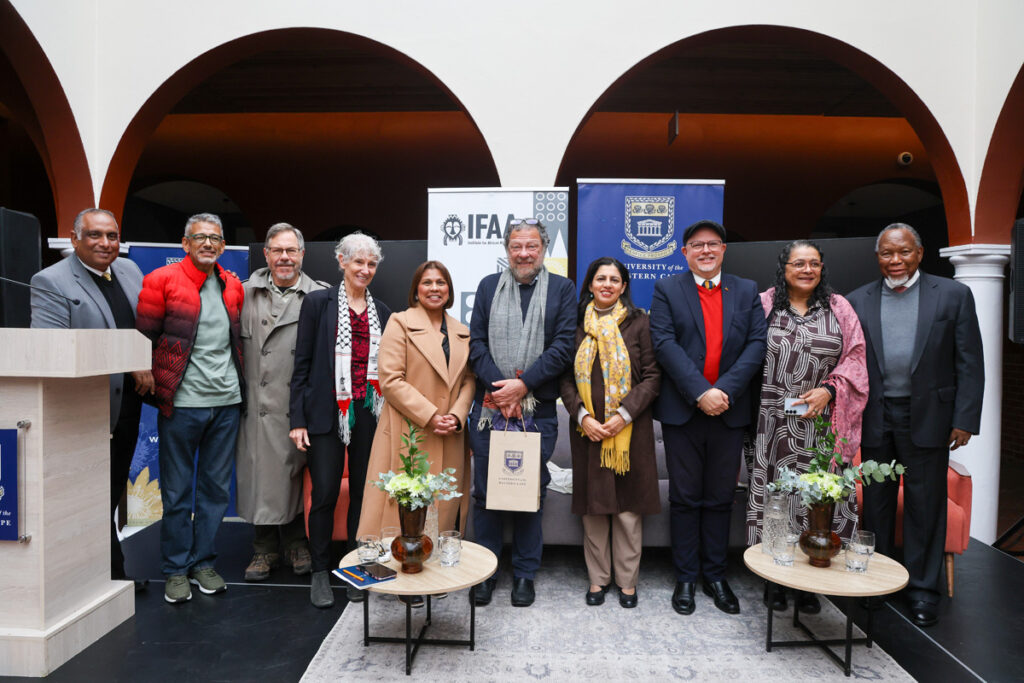
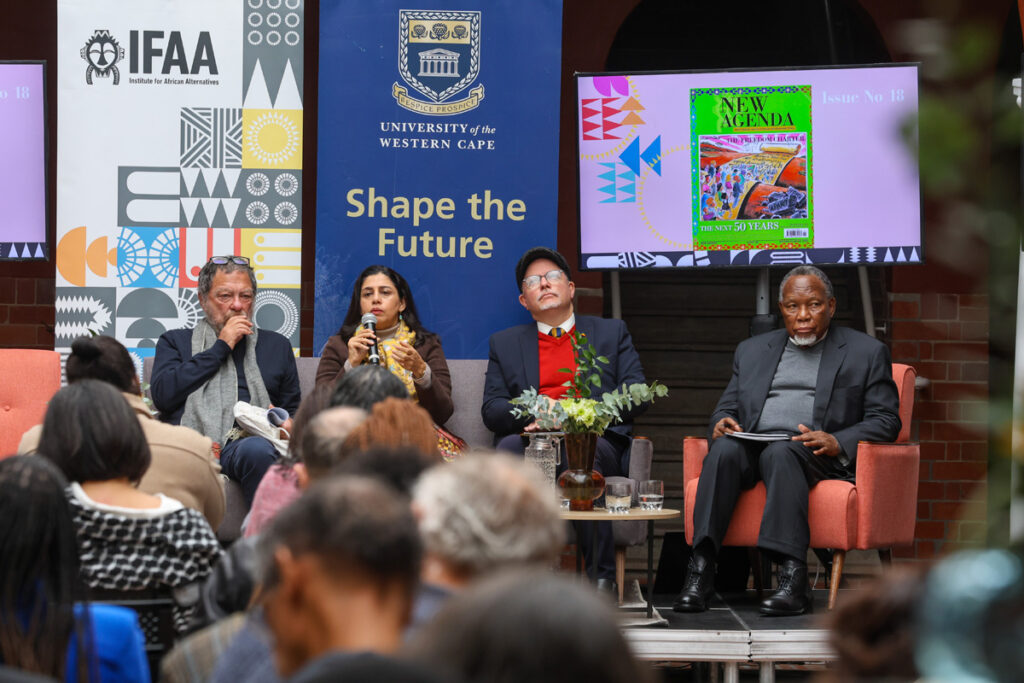
The ISD was delighted join and be associated with the Institute for African Alternatives (IFAA), who held a summit at Iyatsiba Lab in April 2026.

Stephen Devereux was invited by the World Food Programme to deliver the keynote presentation at a ‘solutions session’, introducing “a new era of social protection for food security and nutrition” at the Second World Summit for Social Development (https://social.desa.un.org/world-summit-2025) in Doha, Qatar, on 4 November 2025.
Stephen Devereux was a co-lead of a T20 Task Force under South Africa’s leadership of the G20 in 2025. Devereux co-authored the T20 Communique (https://t20southafrica.org/t20-communique/) and was invited by the T20 Secretariat to speak in plenary at the T20 summit at the Sandton Convention Centre, on 14 November 2025. Devereux spoke about the need to strengthen social protection systems and to build equitable food systems, to address the persistence of global hunger, malnutrition, and famines as 2030 approaches.
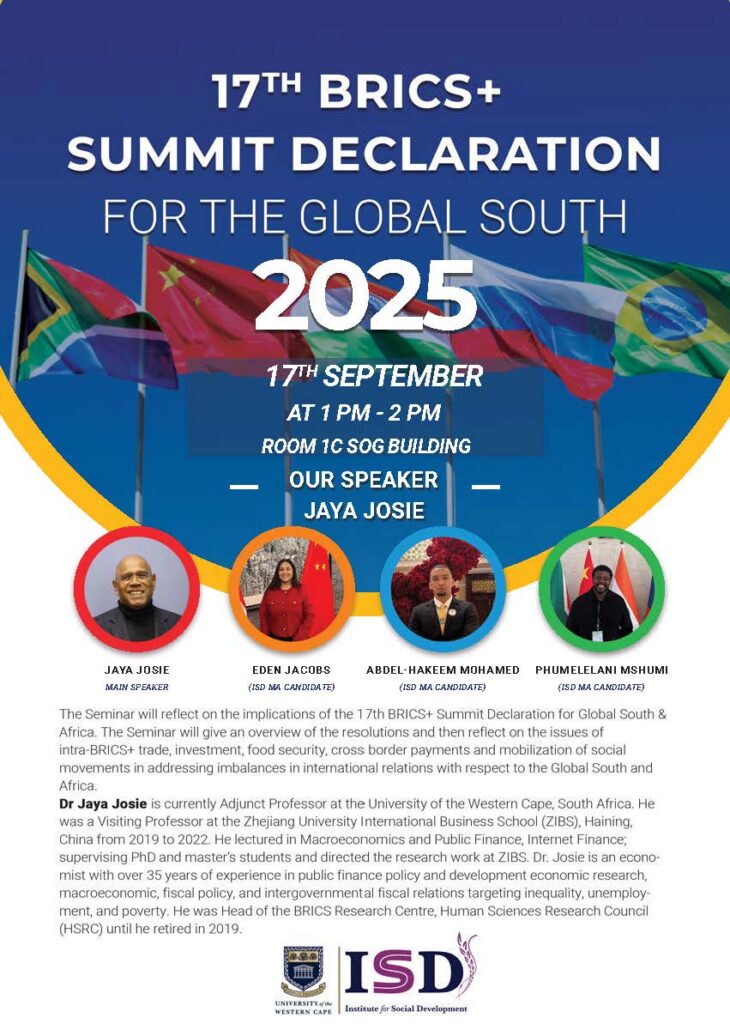
The Seminar will reflect on the implications of the 17th BRICS+ Summit Declaration for Global South & Africa. The Seminar will give an overview of the resolutions and then reflect on the issues of intra-BRICS+ trade, investment, food security, cross border payments and mobilization of social movements in addressing imbalances in international relations with respect to the Global South and Africa.
From seminars and public dialogues to book launches and special events, these materials reflect the Institute’s commitment to engaged scholarship, social justice, and evidence-based responses to inequality, hunger, migration, and political-economic injustice.
View resources
AHMR is an interdisciplinary peer-reviewed on-line journal created to encourage and facilitate the study of all aspects (socio-economic, political, legislative and developmental) of human mobility in Africa.
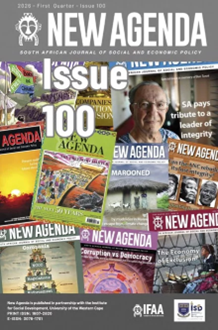
Celebrating 25 years of New Agenda: South African Journal of Social and Economic Policy, this landmark publication honors the distinctive partnership between the University of the Western Cape’s Institute for Social Development (ISD) and civil society. At a time of persistent inequality and stalled transformation, this enduring collaboration underscores the vital role of ideas in shaping a just society—renewing intellectual courage and deepening public engagement.
Project Timeline:
2017–2018
Project Focus:
This study examines refugee and asylum-seeker representative structures, their legitimacy and representativeness, and the ways community-based protection and self-help initiatives function. It also seeks guidance directly from refugees and asylum seekers to help shape a stronger community representation and engagement model in South Africa.
Project locations:
Expected output:
A full report with recommendations for a community representation and engagement model in South Africa.
Research Team:
Prof Mulugeta F. Dinbabo, Prof Yanga Zembe, Dr Sharon Penderis, Mr Sergio Carciotto, Dr Chris Nshimbi, Dr Vanya Gastrow, with several postgraduate researchers from UWC and UP.
Project Timeline:
2017
Project Focus:
Conducting data management and statistical analysis for migration-related research in selected sub-Saharan African countries. The work contributed to two main outputs: an atlas and a working paper.
Project locations:
Expected output:
Research Team:
Prof Mulugeta F. Dinbabo and Mr Michael Nguatem Belebema.
Project Timeline:
2015–2016
Project Focus:
This study explored the relationship between food choices and BMI in adults and children in South Africa, using both secondary data and fieldwork. It looked at what people consumed in Khayelitsha and Mitchells Plain, what shaped their food choices, and how those choices related to health perceptions and actual BMI.
Project locations:
Expected output:
Research Team:
Prof Mulugeta F. Dinbabo, Dr Abdulrazak Karriem, Dr Sharon Penderis, Prof Julian May, Prof Christopher Fulcher, and several postgraduate students.
Key factors identified:
Income, food cost, accessibility, availability, culture, taste, familiarity, knowledge, social setting, time constraints, religion, and travel distance to buy food.
Acting Director; DSTI-NRF-Sasol Foundation SARChI Chair in Local and Regional Economic Development
DAAD Lecturer in Development Studies
Extraordinary Professor; Research Affiliate; SARChl Chair in Social Protection
Director of the DSTI-NRF Centre of Excellence in Food Security (CoE-FS), affiliated to ISD