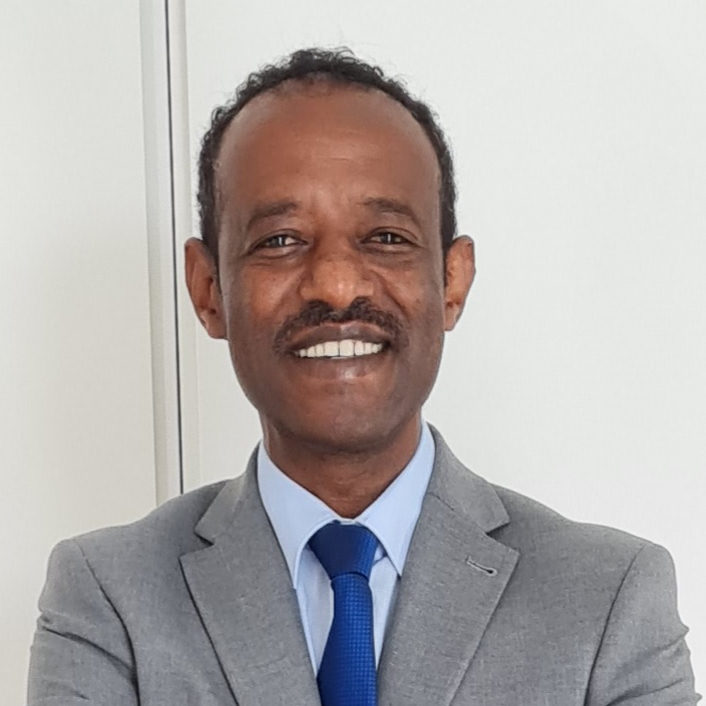
Prof. Mulugeta F. Dinbabo

Prof. Mulugeta F. Dinbabo

Designation: Professor and Postgraduate Coordinator

Email: mdinbabo@uwc.ac.za

Qualifications

  • PhD in Development Studies (University of the Western Cape)
  • MA in Development Studies (University of the Western Cape)
  • MA Development Management (Ruhr University).

Biography

Professor Mulugeta F. Dinbabo is a Professor of Development Studies at the Institute for Social Development, University of the Western Cape (UWC), and an NRF-rated C2 Established Researcher. He holds a PhD in Development Studies from UWC, as well as Master’s degrees in Development Management from Ruhr University, Germany, and Development Studies from UWC.

His academic work is situated at the intersection of development studies, migration and human mobility, and postgraduate teaching and supervision. Over the course of his academic career, Professor Dinbabo has supervised and graduated more than 55 Masters and doctoral students in Development Studies and has published extensively in peer-reviewed national and international journals.

Professor Dinbabo is the founder and Chief Editor of the African Human Mobility Review (AHMR), a Department of Higher Education and Training-accredited interdisciplinary peer-reviewed journal. The journal advances scholarship on the socio-economic, political, legislative and developmental dimensions of migration and human mobility across Africa.

Through his research, postgraduate supervision and editorial leadership, Professor Dinbabo has made a sustained contribution to scholarship and capacity development in development and migration studies, with a particular focus on African development challenges and human mobility.

Research projects

2021-2028: South-South Migration and Migrant Food Insecurity in the Global South (MiFood Project): Co-Investigator (Co-I)

MiFood is an international research initiative funded by the Social Sciences and Humanities Research Council of Canada (SSHRC). The project brings together a multidisciplinary network of partner institutions, co-investigators and collaborators from seven Canadian universities and research teams across the Global South, including partners in China, Jamaica, Kenya, Mexico, Namibia, Mozambique, Ecuador, Ghana, India, Qatar, South Africa and Singapore.

The project investigates the relationship between migration and food security, with particular attention to international and internal South–South migration. Its objectives are to develop a global research and knowledge-mobilisation agenda on migration and food security; compare the food-security vulnerabilities of migrant women, men and children across cities, migration corridors and migrant-sending communities; examine how changing food systems contribute to migration, precarious employment and food insecurity; and strengthen the visibility of the migration–food security nexus within global, national and local development agendas.

MiFood’s distinctive contribution lies in its comparative, interdisciplinary and Global South-focused approach. It seeks to generate new evidence on how migration can contribute positively to food security while also identifying the structural vulnerabilities affecting rapidly growing migrant populations and their dependants.

2025-2027: Remitting for Resilience (R2) Project: In collaboration with Balsillie School of International Affairs and Wilfrid Laurier University. Co-Investigator (Co-I),

The Project research focuses on a number of contrasting migration and remittance corridors. Migration corridors are a useful framing device “to understand the movement of people, goods, money, knowledge and skills between two places with sociocultural, economic, political and historical dynamics that transcend national borders” (MIDEQ, 2023). All migration corridors have certain common features, most notably the flow of remittances in cash and kind from migrant destinations to origins. In some remittance corridors, there is also a reverse flow of food remittances from origins to destinations. However, there is also considerable variation between corridors in terms of inter alia the motivations and ability of migrants to remit; the volumes, types and frequencies of bi-directional remittance flows; who receives and controls remittance income and decides on the uses to which they are put; the regulatory environment governing cross-border financial transactions; the differences between corridors that straddle international borders and those that do not; the relative balance between formal and informal remittances; the types, costs and speed of different remittance channels; and the extent to which senders and recipients have access to digital and mobile money options. For this study, the first of its kind, we have selected a group of international and internal remittance corridors with one major common feature: that is, the migrant-sending and remittance-receiving end of the corridor is located geographically in rural communities in marginal environments.

2022-2025: Assessing and Mitigating the Food Insecurity Impacts of COVID-19 on Marginalized Refugees from Countries in Crisis (R350 000.00): In collaboration with Balsillie School of International Affairs and Wilfrid Laurier University, Co-Investigator (Co-I)

Strategies to mitigate the public health impacts of COVID-19 have led to a secondary pandemic of global food insecurity. Our project will ‘scale up’ our First Round CIHR Grant on the negative impacts of COVID-19 on household food security in Wuhan and Nanjing, China to three additional cities: Quito (Ecuador), Cape Town (South Africa) and Kitchener-Waterloo (K-W) (Canada). The project has a particular focus on the food insecurity experience of marginalized immigrant and refugee populations during the pandemic and how to build greater resilience post-pandemic. We will undertake a comparative study of the food security and related health impacts of COVID-19 on immigrants and refugees who have settled in these three cities and who come from countries experiencing political and economic crises or natural disasters: in Quito, migrants from Venezuela and Haiti; in Cape Town, migrants from the DRC, Somalia and Zimbabwe; and in K-W, refugees from Afghanistan and Syria. In all three study sites, we have research partners and infrastructure in place as well as ongoing projects on gender violence against migrants (Quito), refugee livelihoods (Cape Town) and the social determinants of refugee health (K-W).

Publications

  • Agboola, S., Dinbabo, M. F., & Sithole, S. (2025). Sustainable development in the digital age: Harnessing technology for global climate partnership in Africa. African Journal of Public Administration and Environmental Studies, 4(2), 221–248. https://hdl.handle.net/10520/ejc-aa_ajopaes_v4_n2_a11
  • Dinbabo, M. F., & Mazani, P. (2025). Sustainable development goals and policy frameworks for development in Africa. New Agenda: South African Journal of Social and Economic Policy, 96(1), 50–61. https://doi.org/10.14426/na.v96i1.2518
  • Dinbabo, M. F., Belebema, M., & Quarshie, E. (2025). South–South migration: Towards a regional research agenda. In J. Crush, A. Chikanda, & S. Ramachandran (Eds.), New directions in South-South migration. Springer. https://doi.org/10.1007/978-981-97-9715-8_26
  • Egenti, S., & Dinbabo, M. F. (2025). International migration, remittance flows, and economic growth among West African countries. African Journal of Business and Economic Research, 20(4), 127–149. https://doi.org/10.31920/1750-4562/2025/v20n4a6
  • Kanyayi, J., Nel, C., Dinbabo, M. F., & Sithole, S. (2025). An assessment of climate change and migration governance in Africa. African Journal of Public Administration and Environmental Studies, 4(4), 297–323. https://hdl.handle.net/10520/ejc-aa_ajopaes_v4_n4_a14
  • Mazani, P., & Dinbabo, M. F. (2025). Climate change and migration: A call for a continental-level research agenda. African Journal of Public Administration and Environmental Studies, 4(1), 45–66. https://doi.org/10.31920/2753-3182/2025/v4n1a3
  • Sithole, S., Tevera, D., & Dinbabo, M. F. (2025). Digital technologies and food remitting patterns among Zimbabwean migrants in South Africa during COVID-19. In J. Crush, A. Chikanda, & S. Ramachandran (Eds.), New directions in South-South migration. Springer. https://doi.org/10.1007/978-981-97-9715-8_24
  • Adeniyi, D. A., Carciotto, S., & Dinbabo, M. F. (2024). African migrations research: An annotated bibliography. Strategic Review for Southern Africa, 46(1), 201–253. https://doi.org/10.35293/srsa.v46i1.5204
  • Dinbabo, M. F. (2024). Ethiopian diasporans in South Africa: Dynamics of migration, opportunities, and challenges. In S. Gulema, H. Girma, & M. F. Dinbabo (Eds.), The global Ethiopian diaspora: Migrations, connections, and belongings (pp. 126–149). Boydell & Brewer. https://doi.org/10.1515/9781805432814-007
  • Gulema, S. B., Girma, H., & Dinbabo, M. F. (Eds.). (2024). The global Ethiopian diaspora: Migrations, connections, and belongings. Boydell & Brewer. https://doi.org/10.1515/9781805432814
  • Gulema, S. B., Girma, H., & Dinbabo, M. F. (2024). Transnational migration and the making of the global Ethiopian diaspora. In S. B. Gulema, H. Girma, & M. F. Dinbabo (Eds.), The global Ethiopian diaspora: Migrations, connections, and belongings (pp. 1–26). Boydell & Brewer. https://doi.org/10.1515/9781805432814-002
  • Sithole, S. T., Dinbabo, M. F., & Tevera, D. (2024). Sustainable Development Goals (SDGs), COVID-19 lockdowns and digitalisation of food remittance flows from South Africa to Zimbabwe: Lessons learnt and reflections on policies. African Human Mobility Review, 10(3), 201–253. https://doi.org/10.14426/ahmr.v10i3.2436
  • Sithole, S. T., Tevera, D., & Dinbabo, M. F. (2024). Digital technologies and food remitting by Zimbabwean migrants in South Africa. MiFOOD Policy Brief No. 10. MiFOOD. https://mifood.org/wp-content/uploads/2024/10/MiFOODBrief10.pdf
  • Badewa, A. S., & Dinbabo, M. F. (2023). South Africa’s political commitment to the promotion and protection of the rights of vulnerable groups. In I. Ile & O. Fagbadebo (Eds.), Democracy and political governance in South Africa. Springer. https://doi.org/10.1007/978-3-031-16313-5_6
  • Ikebuaku, K., & Dinbabo, M. F. (2023). Exploring the dynamics of agripreneurship perception and intention among the Nigerian youth. International Journal of Management, Entrepreneurship, Social Science and Humanities, 6(2), 94–115. https://doi.org/10.31098/ijmesh.v6i2.1222
  • Sithole, S., Tevera, D., & Dinbabo, M. F. (2023). Emerging digital technologies and cross-border food remittances of Zimbabwean migrants in Cape Town, South Africa, during the early COVID-19 pandemic. MiFOOD Paper No. 9. MiFOOD. https://mifood.org/wp-content/uploads/2024/08/MiFOOD9-Emerging-Digital-Technologies.pdf
  • Dinbabo, M. F. (2022). COVID-19 lockdown and peri-urban livelihoods: Migrants’ contribution to the South African food system. In P. Angu, T. Masiya, K. Gustafsson, & N. Mulu (Eds.), South African-based African migrants’ responses to COVID-19 (pp. 101–125). Langaa RPCIG. https://tinyurl.com/38syar5t
  • Egenti, S., & Dinbabo, M. F. (2022). Evaluating the development impact of Fadama III project on smallholder farmers: Empirical evidence from Ebonyi State, Nigeria. African Journal of Governance and Development, 11(1.1), 125–145. https://doi.org/10.10520/ejc-ajgd_v11_n1.1_a7
  • Nzabamwita, J., & Dinbabo, M. F. (2022). International migration and social protection in South Africa. Cogent Social Sciences, 8(1), 2144134. https://doi.org/10.1080/23311886.2022.2144134
  • Sithole, S., Tevera, D., & Dinbabo, M. F. (2022). Cross-border food remittances and mobile transfers: The experiences of Zimbabwean migrants in Cape Town, South Africa. Eutopía: Revista de Desarrollo Económico Territorial, 22, 10–32. https://doi.org/10.17141/eutopia.23.2022.5799
  • Badewa, A. S., & Dinbabo, M. F. (2022). Multisectoral intervention on food security in complex emergencies: A discourse on regional resilience praxis in Northeast Nigeria. GeoJournal, 87(3), 1231–1250. https://doi.org/10.1007/s10708-022-10679-4
  • Badewa, A. S., & Dinbabo, M. F. (2021). Irregular migration and regional security complex in the Sahel-Lake Chad Corridor: A human security discourse. Ìrìnkèrindò: A Journal of African Migration, 12, 123–157. https://tinyurl.com/ycv9mvck
  • Boakye, A., & Dinbabo, M. F. (2021). Alleviating poverty and achieving inclusive growth through digital innovations: Evidence from South Africa. Journal for Creativity, Innovation and Social Entrepreneurship, 5(2), 20–28. https://sarchi.org/wp-content/uploads/2022/04/135097-JCISE-Vol-5-Issue-2-2021.pdf#page=20
  • Boakye, A., Nwabufo, N., & Dinbabo, M. F. (2021). The impact of technological progress and digitization on Ghana’s economy. African Journal of Science, Technology, Innovation and Development, 14(7), 1981–1986. https://doi.org/10.1080/20421338.2021.1994239
  • Dinbabo, M. F., Badewa, A. S., & Yeboah, C. (2021). Socio-economic inequity and decision-making under uncertainty: West African migrants’ journey across the Mediterranean to Europe. Social Inclusion, 9(1), 216–225. https://doi.org/10.17645/si.v9i1.3663
  • Dinbabo, M. F., Zembe, Y., Carciotto, S., Chiwarawara, K., Belebema, M., & Ahmed, M. (2021). Refugee and asylum-seeking representative structures in South Africa: The case study of Somali, Congolese, and Ethiopian communities. Journal of Refugee Studies, 34(4), 3771–3792. https://doi.org/10.1093/jrs/feaa107

Related News